
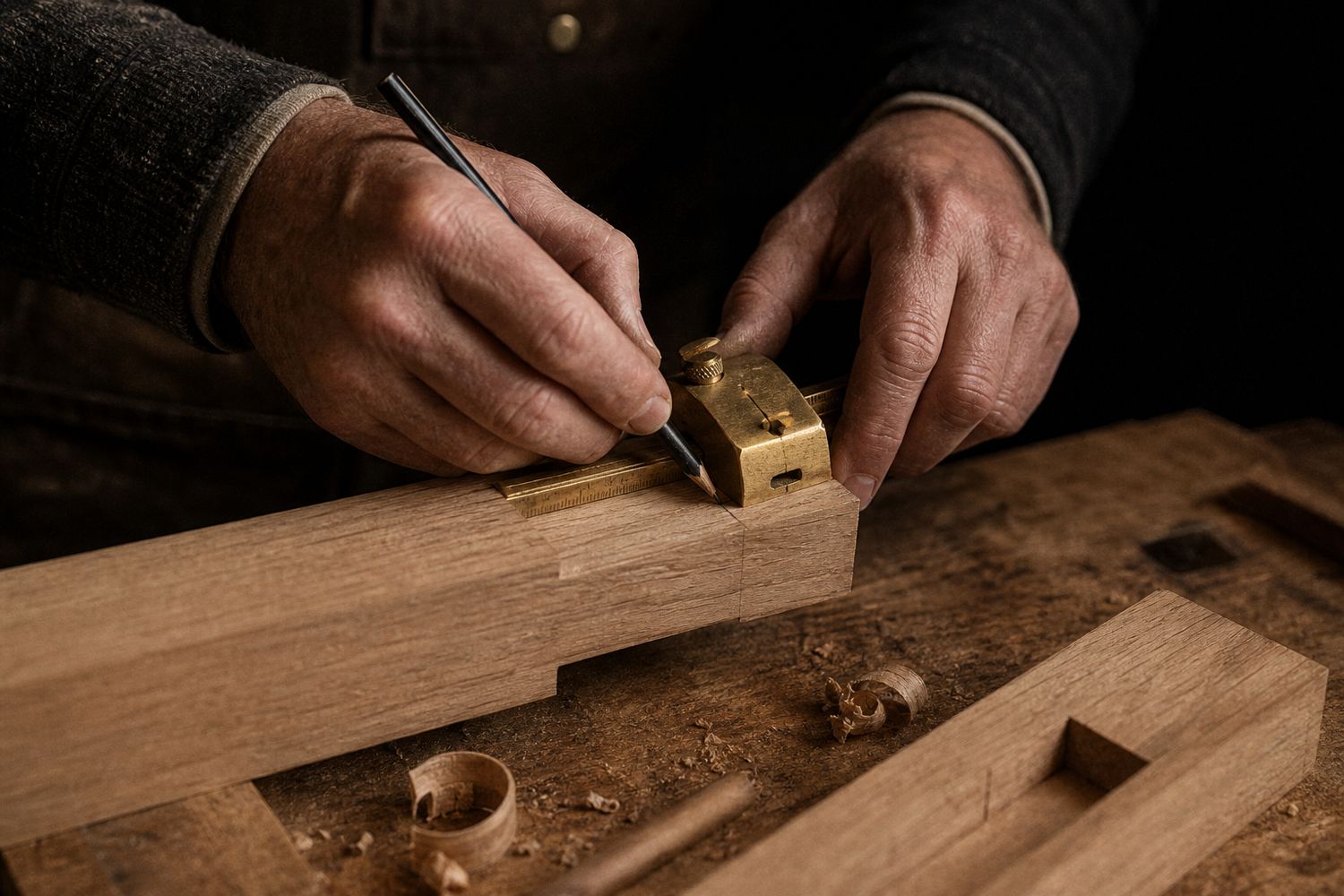
Wood does not arrive as neutral material. Every board is a record of growth, weather, stress, milling, and drying. Grain is the visible trace of that history, but it is also a map of likely movement and resistance. Reading it before making a cut is one of the simplest ways to improve both the appearance and the life of a piece.
Begin at the whole board
Before marking parts, stand the board upright and look from several distances. At arm’s length, note the dominant figure and any shift from straight grain to cathedral patterns. Up close, look for runout, small checks, knots, mineral streaks, and changes near the edges. Then sight down the length to understand cup, bow, and twist. These observations determine which parts the board can become with the least coercion.
A furniture drawing may show four identical rails, but the material rarely offers four identical candidates. The quietest grain might belong on a front edge where it can support the overall line. A more animated section can serve a broad panel. Short grain around a knot may be beautiful but unsuitable near a narrow tenon. Layout is an editorial act: the maker decides what to emphasize, what to pair, and what not to ask the material to do.
Direction changes the cut
Handplanes and edge tools work by lifting and severing fibers. When fibers rise toward the cutting direction, the edge can dive under them and tear below the intended surface. Reversing direction, reducing the cut, sharpening the iron, or changing to a higher cutting angle may solve the problem. On boards with reversing figure, no single direction is safe everywhere; localized scraping or careful sanding can be more honest than forcing a continuous planing pass.
Movement belongs in the design
Wood exchanges moisture with the surrounding air, expanding and contracting mostly across the grain. The amount varies by species, cut, and climate. A solid tabletop fixed rigidly across its width may split or distort. A frame-and-panel door works because the frame provides structure while the panel is permitted to move inside its groove.
This is not a defect to engineer away. It is a condition to accommodate through elongated screw holes, buttons, sliding dovetails used with care, or joinery that restrains one axis while releasing another. In Kansas City, seasonal humidity shifts are significant enough that allowance cannot be an afterthought. Final dimensions, finish schedule, and installation environment all matter.
Figure and continuity
When several parts meet, grain can clarify the construction. Continuous figure across drawer fronts makes a cabinet face feel calm. Quarter-sawn oak can give vertical members a steadier rhythm. Bookmatching can create symmetry, but symmetry is not automatically better; in a restrained piece it may become the loudest gesture. We use it only when the object benefits from a clear center.
Color matching also requires patience. Freshly milled heartwood can change with light and oxygen, while oil deepens contrast. Wetting a prepared surface with mineral spirits offers a temporary preview without committing to a finish. Samples made from actual offcuts are more useful than generic swatches because they include the same color, pore structure, and preparation sequence as the piece.
Finish follows use
A film finish can offer strong resistance, while a penetrating oil may be easier to renew. Neither is universally superior. A dining surface, cabinet interior, stool, and wall object encounter different abrasion, moisture, and maintenance habits. The finish should respond to those conditions and preserve the intended tactile quality.
We keep finishing schedules legible: product, preparation grit, number of coats, curing time, and future maintenance. The owner should not need specialist knowledge to care for an everyday object. A repairable surface and an understandable care note extend useful life more reliably than a grand claim about permanence.
From rough stock to stable parts
Reading grain continues through milling. Removing equal amounts from both faces is a useful starting habit, but it is not a substitute for watching what the board does after each operation. A board carrying internal stress may shift as soon as its outer fibers are released. For critical components, we mill in stages: flatten and thickness the stock slightly oversize, allow it to rest with air reaching both faces, then inspect and bring it to final dimension later.
Reference faces and edges should remain clearly marked. Those marks establish which surfaces register against fences, jigs, and adjoining parts. Without them, a small wedge or twist can migrate through an assembly and become much harder to diagnose. The practice feels slow only until it prevents a case from racking or a set of doors from refusing to align.
Matching boards across an object
Selection is not simply a search for the most dramatic figure. The boards should support the hierarchy of the object. On a cabinet, broad doors may carry visual movement while narrow stiles remain quiet. On a table, top boards can be arranged so adjacent growth-ring patterns transition rather than collide. We lay components together under the light in which the finished piece is likely to be seen, then turn and reorder them before making permanent marks.
End grain deserves equal attention. It reveals whether a board is plain-sawn, rift-sawn, or quarter-sawn and offers clues about how it may move. Orientation can also change the visual weight of an edge. When boards are joined into a wide panel, alternating ring direction is sometimes proposed as a universal rule. In reality, good drying, appropriate stock selection, sound joinery, and a stable support system matter more than a decorative up-and-down formula.
Defects can become decisions
A check, knot, bark inclusion, or mineral streak is not automatically waste. Its value depends on location and purpose. A sound knot in a broad, lightly loaded panel may become a useful point of character. The same knot crossing a chair rail can interrupt the long fibers that provide strength. Small defects can sometimes be cut away, stabilized, or placed where a joint removes them, but concealment should never substitute for structural judgment.
We draw defects on rough layouts and include a margin around uncertainty. This makes yield estimates more honest. It also helps explain why bespoke work cannot always be priced by nominal board footage alone: two boards of the same size may offer very different quantities of suitable, visually related parts.
Documenting the material story
For larger commissions, we photograph selected boards and keep offcuts labeled through the finishing stage. The record helps if a replacement component is needed and gives the client a clear account of material choices. Useful documentation includes species, supplier, approximate moisture reading, milling date, finish sample, and final maintenance schedule. It is not bureaucracy for its own sake; it preserves knowledge that otherwise disappears when the bench is cleared.
Offcuts also become test pieces. We use them to confirm glue behavior, edge-tool setup, color, pore filling, sheen, and repair methods. A finish sample made on unrelated timber cannot predict how the actual piece will respond. Testing the real material turns the inevitable variation of wood into information.
Buying and acclimating stock
Responsible selection begins before the boards enter the workshop. A species should suit the object’s structural demands, expected wear, desired tone, and available supply. We ask suppliers about origin and drying rather than treating a species name as the whole specification. Locally or regionally available timber can reduce transport and make future repair easier, but it still needs careful grading. Wider, clearer, or unusually figured material should be reserved for places where it produces a real benefit.
Moisture readings are useful when interpreted in context. A meter offers a sample, not certainty about an entire board, so readings should be taken at several locations and compared across the batch. Stock then rests with stickers between layers so air can reach both faces. Acclimation does not mean leaving timber untouched for an arbitrary week; it means allowing its condition to approach the environment where it will be milled and, as far as practical, where the object will live.
The workshop and final room may differ. A piece built in a humid open shop and installed beside winter heating will encounter a sharper transition than one made in controlled conditions. We discuss those realities early, avoid promising impossible immobility, and design joints and clearances that remain composed as the seasons change.
Repair begins at construction
Grain-aware construction also anticipates future care. Mechanical fasteners should remain reachable where components may need replacement. Adhesive should be selected for the joint rather than used to compensate for poor fit. Surfaces likely to receive wear should be accessible for cleaning, gentle abrasion, and renewed finish without dismantling the whole object.
We keep a small quantity of matching material when a commission includes distinctive stock. It may become a replacement pull, patch, or test piece years later. This modest archive recognizes that longevity is not invulnerability. Durable work survives because its changes are understood and because someone has left a reasonable path to repair.
The first cut is a conclusion
By the time a board reaches the saw, the most important work may already be complete. Its parts have been assigned with movement, strength, figure, and waste in mind. The cut is not the beginning of making but the conclusion of close observation. That habit—looking long enough for the material to influence the plan—is one of the foundations of durable craft.